

AI in B2B: Navigating the Future of Business to Business — Key Takeaways From Our Webinar
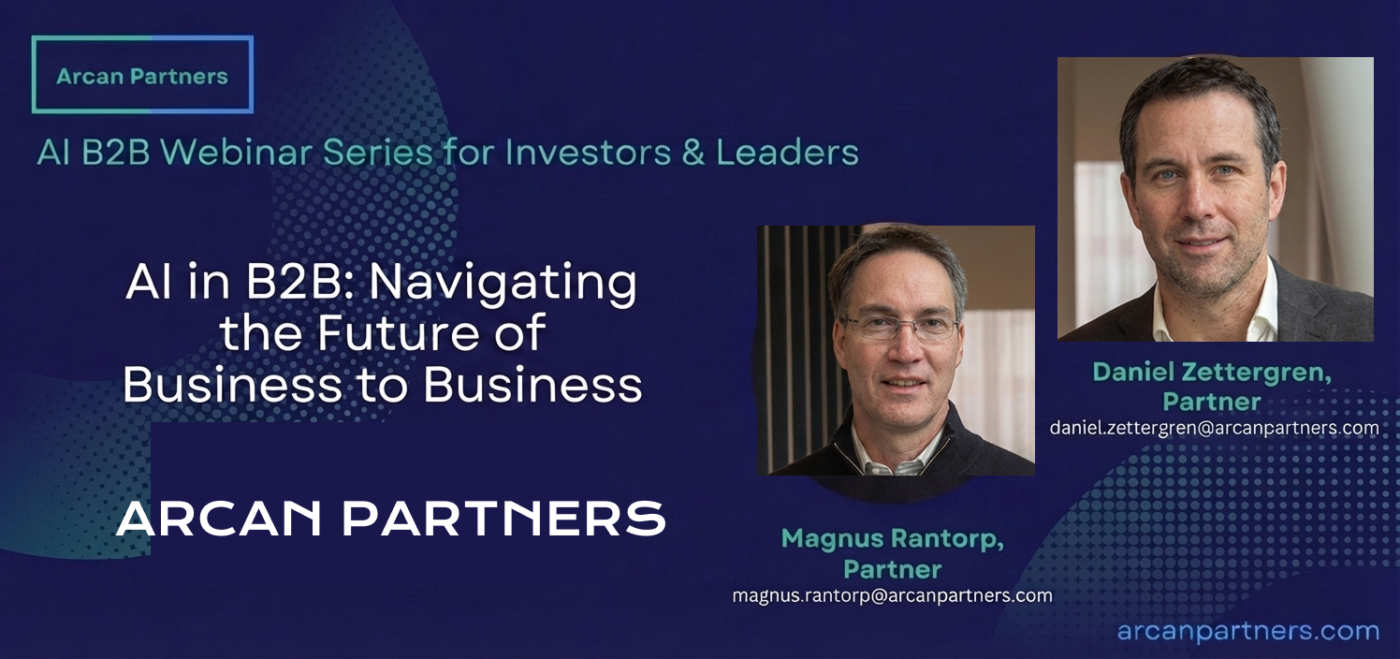
Earlier this month, Arcan Partners hosted an engaging session as part of our AI B2B Webinar Series for Investors and Leaders. Partners Magnus Rantorp and Daniel Zettergren led the conversation on one of the most pressing topics in enterprise software today: how artificial intelligence is fundamentally reshaping the way B2B companies build products, acquire customers, and scale operations.
The session brought together software founders, investors, and technology executives for a candid discussion about what AI actually means for B2B businesses in practice — beyond the hype cycle and investor narratives. The conversation was grounded in what we see across our portfolio and in the hundreds of companies we evaluate each year: AI is not a feature to be bolted on. It is an architectural shift that changes how software companies compete, how they price, and ultimately how they win.
What made this session particularly valuable was the diversity of perspectives in the room. We heard from founders who are shipping AI-native products today, operators who are rebuilding internal workflows around automation, and investors trying to separate sustainable AI businesses from those riding a temporary wave of enthusiasm. The consensus was clear: the companies that treat AI as a strategic foundation rather than a marketing label will be the ones that define the next era of enterprise software.
Magnus opened with a provocation that set the tone for the entire discussion: the biggest risk for B2B software companies today is not that they adopt AI too aggressively — it is that they adopt it too superficially. Wrapping an LLM around an existing product does not make a company AI-native. The real opportunity lies in rethinking the entire value chain — from how products are built and delivered to how customer success is managed and how pricing reflects the value AI creates.
Daniel followed with a deep dive into what we are seeing on the investment side: how AI is compressing the timeline from founding to product-market fit, why vertical AI applications are outperforming horizontal ones in B2B, and why the most interesting companies we are backing right now are those using AI to enter markets that were previously too expensive to serve with traditional software.
The Q&A session was one of the liveliest we have had in the series, with particularly robust debate around pricing models for AI-powered products and whether usage-based pricing will replace seat-based licensing as the dominant model in enterprise software.
Key Topics We Covered
AI-Enhanced vs AI-Native Business Models. Why the distinction between adding AI features to an existing product and building a company around AI from the ground up matters fundamentally — for product strategy, unit economics, and how investors evaluate the opportunity.
Compressing the Path to Product-Market Fit. How AI tools are enabling early-stage B2B startups to build, test, and iterate faster than ever — and what that means for founding teams, development timelines, and the capital required to reach meaningful traction.
Vertical Over Horizontal. Why industry-specific AI applications are consistently outperforming broad horizontal platforms in B2B, and where we see the strongest opportunities for vertical AI companies to build durable competitive advantages.
Unlocking Previously Uneconomical Markets. How AI-native companies can profitably serve customer segments and use cases that were too expensive to address with traditional SaaS — creating entirely new categories rather than competing in existing ones.
Go-to-Market in the AI Era. How AI is changing B2B sales and distribution — from product-led growth and AI-assisted onboarding to automated customer success workflows that reduce the cost of serving mid-market and SMB customers.
Engineering Teams and Development Velocity. The impact of AI coding tools on software development speed, team composition, and hiring strategy — and why smaller, more senior engineering teams are increasingly outperforming larger ones.
Pricing Strategy for AI Products. The tension between seat-based licensing, usage-based models, and outcome-based pricing. Why getting pricing right is one of the highest-leverage decisions an AI-powered B2B company can make — and why most get it wrong.
Incumbent Response and Vulnerability Windows. How established enterprise software companies are responding to AI-native challengers, where the biggest gaps in their defences exist, and how long those windows of opportunity remain open.
Data as a Defensible Moat. Why proprietary data — customer data, workflow data, industry-specific training data — is emerging as the most durable competitive advantage for AI-powered B2B companies, and how founders should think about building data moats from day one.
Retention in an Automated World. How customer retention dynamics change when AI automates workflows that previously required hands-on human effort — and why some AI products create stronger lock-in while others inadvertently reduce switching costs.
AI in Back-Office Operations. How B2B software companies are using AI to transform their own internal operations — from finance and HR to customer support — and the productivity gains we are seeing across our portfolio.
What We Look For at Seed and Series A. The signals that separate genuine AI innovation from surface-level packaging when we evaluate early-stage companies — including technical differentiation, data strategy, and the founder’s depth of understanding of the problem they are solving.
Regulatory Landscape. What B2B software founders need to know about the EU AI Act, emerging AI governance frameworks, and how regulatory requirements are shaping product architecture decisions — particularly for companies selling into regulated industries.
Sector Dynamics in Fintech, Insurtech, and Industrial Software. How AI is reshaping competitive dynamics in three sectors where we see the most activity — and where the next generation of category-defining companies is most likely to emerge.
Practical Frameworks for Founders. How to evaluate where AI creates genuine product value versus where it adds complexity without clear ROI — a framework we use internally and shared with attendees to help prioritise AI investments.
We want to thank everyone who joined the session and contributed to what was a genuinely substantive conversation. These webinars are most valuable when the discussion goes beyond surface-level AI enthusiasm and into the operational realities of building and scaling software companies in a market that is changing faster than most people appreciate.
If you missed this session or would like to be included in future events in our AI B2B Webinar Series, reach out to us at contact@arcanpartners.com. We will be announcing the next session topic shortly.
